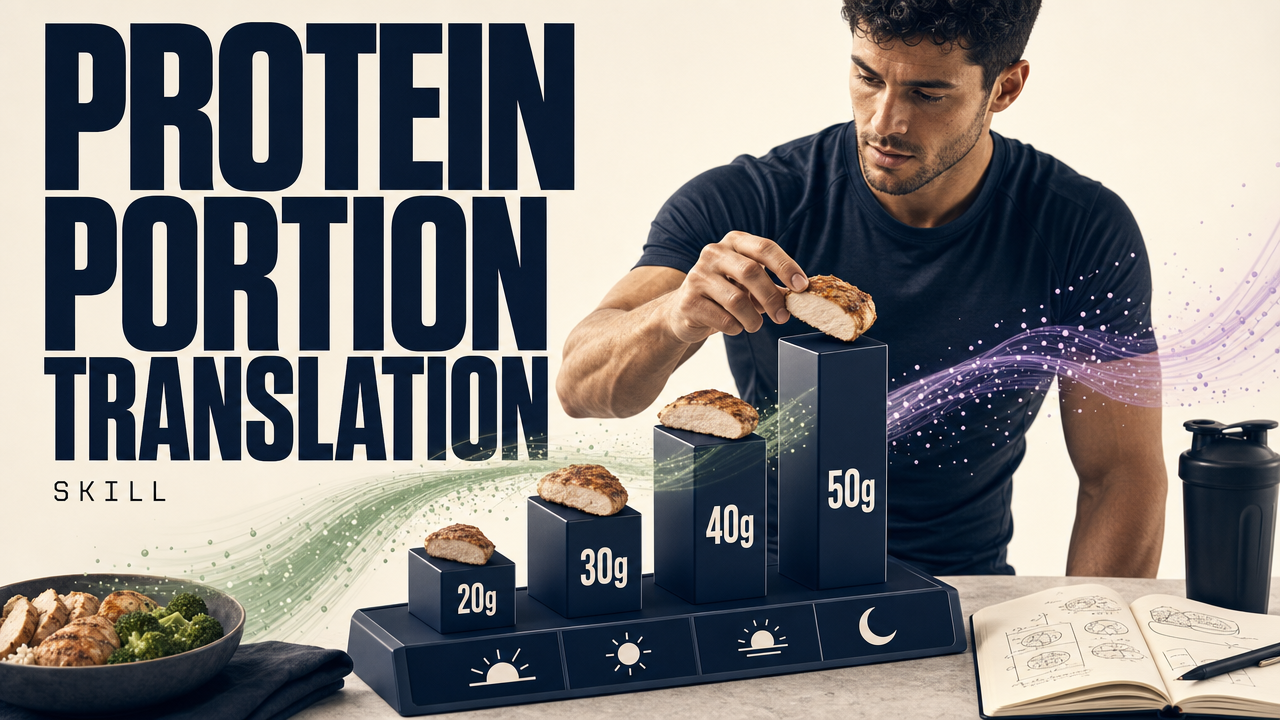
protein portion translation
v1by FitnessGrid
An educational program to translate numerical protein targets into visual portions and meal slots using evidence-based heuristics.
proteinnutrition-educationmeal-planningportions
Get an AI coach that uses this skill
FitnessGrid is an AI coach that plans your week and adapts as you go. Install protein portion translation and your coach will follow this protocol every week, learn from what you actually do, and adjust on the fly.
- Your coach builds the week from this skill
- Adapts to your actual progress, not a static template
- Free to start — no credit card, ~60 seconds to set up
Procedure
-
Calculate Evidence-Based Protein Targets
- Determine the user's daily protein requirement using
compute_protein_target. - Apply the following multipliers based on user goals:
- General Health (RDA): 0.8 g/kg
- Active/Maintenance: 1.2–1.6 g/kg
- Strength/Hypertrophy: 1.6–2.4 g/kg
- Aging/Recovery: 1.2–1.5 g/kg
- Determine the user's daily protein requirement using
-
Define Meal Slots and Timing
- Divide the total daily target into 3–5 "protein slots" to ensure even distribution.
- Aim for 20–40g of protein per meal (or approximately 0.4–0.5 g/kg per meal) to maximize muscle protein synthesis.
- Advise the user to avoid "back-loading" (consuming most protein at dinner).
-
Translate Grams to Visual Portions (The Palm Method)
- Coach the user on the Palm Heuristic: 1 palm-sized portion of dense protein (meat, fish, soy, eggs) is approximately 20–30g of protein.
- Calculate the number of "palms" required per meal based on their targets (e.g., a 30g target = 1 palm).
-
Identify Protein Anchors
- Help the user identify "protein anchors" for their meals.
- Focus education on protein density in sources like poultry, fish, tofu, and legumes.
- Instruct the user on label literacy: looking for protein grams per serving rather than just total calories.
-
Implement Behavioral Strategies
- Use an Addition Mindset: Suggest adding high-protein items (e.g., 15g Greek yogurt) to existing meals rather than restricting food.
- Set a SMART goal for the current week (e.g., "Add one 25g protein anchor to breakfast every day").
- Create a summary note for the user using
create_notedetailing their "Palm" targets and meal distribution plan.
-
Monitor Satiety and Adherence
- Instruct the user to log subjective hunger 2–3 hours after a meal.
- If hunger is high, suggest increasing the protein portion size for that specific meal slot in the next session.


