Sections
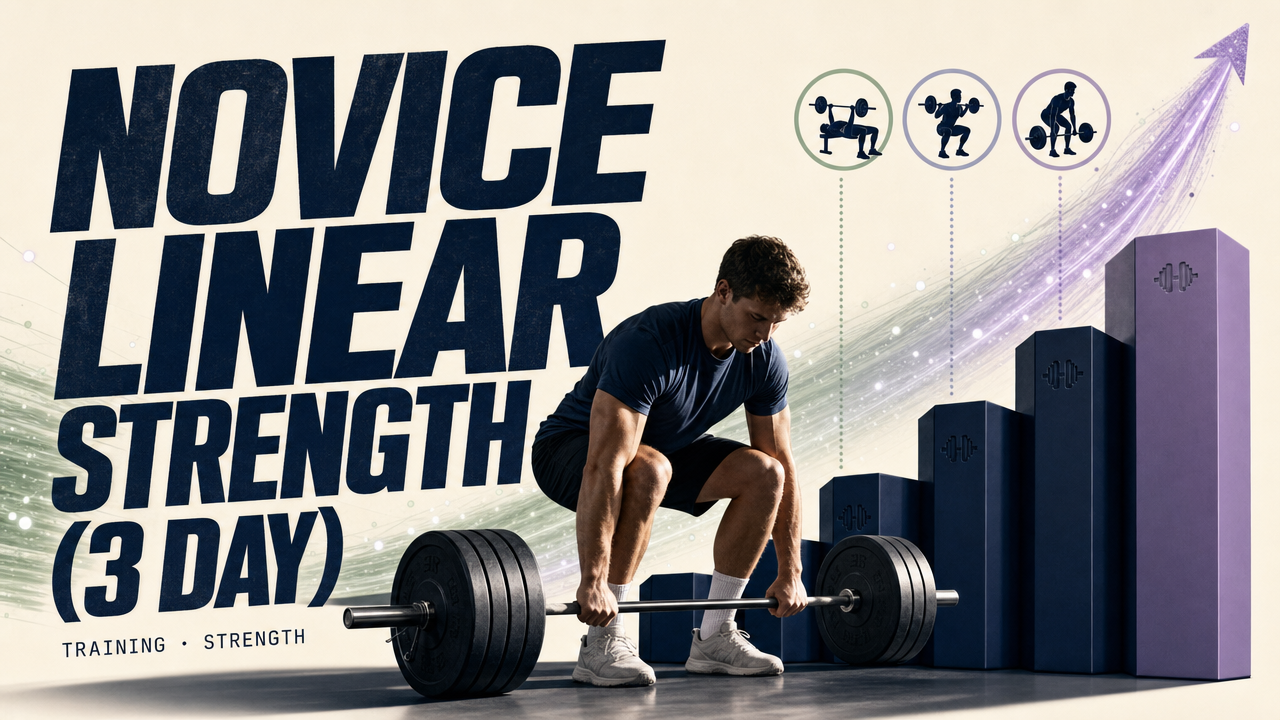
Novice linear strength (3-day)
v2by FitnessGrid
Three sessions a week, two alternating templates, every lift goes up next session. The fastest progress curve a beginner gets and the only programme they need for their first three to six months.
Get an AI coach that uses this skill
FitnessGrid is an AI coach that plans your week and adapts as you go. Install Novice linear strength (3-day) and your coach will follow this protocol every week, learn from what you actually do, and adjust on the fly.
- Your coach builds the week from this skill
- Adapts to your actual progress, not a static template
- Free to start — no credit card, ~60 seconds to set up
Three sessions a week, two alternating templates. The user adds weight every session that's completed. That's it. The whole edifice of intermediate programming exists because this stops working — but while it works, nothing beats it.
- Workout A: Squat 3x5, Bench 3x5, Barbell row 3x5
- Workout B: Squat 3x5, Overhead press 3x5, Deadlift 1x5
Rotation across the week: A, B, A — next week: B, A, B — alternating. The user squats every session because squats drive the engine of linear progress. Deadlift is once a week (max twice) because volume on deadlift kills recovery.
Decision rules for the coach
- Starting weights. If
analyze_training_historyshows any recent gym history (last 4 weeks), use the most recent top set minus 10-15% as the working weight. Otherwise: start at the bar for bench / OHP / row, bar + a pair of warmup plates for squat / deadlift. Don't ask the user to guess a 1RM — they don't have one. - Add weight every session. After a successful 3x5 (all sets,
all reps, RPE 8 or below), add 2.5kg to upper lifts and 5kg to
lower lifts for the next session. Use
evaluatefor the math. - Two failures = reset. If the user misses any rep across two
consecutive sessions on a lift, deload that lift to 90% of the
failed weight and rebuild. After a second deload, the linear
progression has run out — graduate the user to
full-body-3dayorupper-lower-4day. - Form takes precedence over load. If form breaks down on squat or deadlift, hold the weight. Suggest filming a set and reviewing before adding load again.
- No accessories yet. This programme is intentionally bare. Don't add curls, calf raises, abs. The user has 6+ months of productive linear progress to mine — accessories come after.
- Deload trigger. No scheduled deloads. Run a deload week only on the second stall (see "two failures = reset").
- Arithmetic. Use
evaluatefor every weight calculation (per theevaluate-arithmeticskill).


