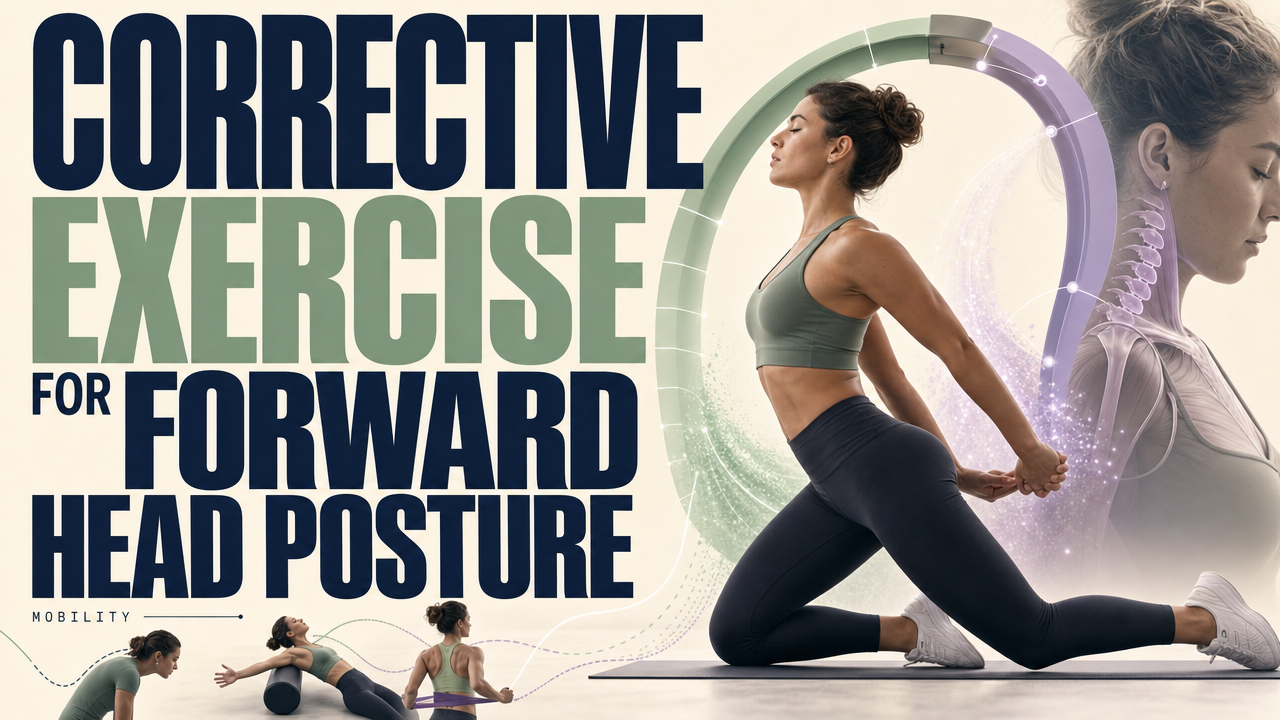
corrective exercise for forward head posture
v1by FitnessGrid
Evidence-based programming to improve the craniovertebral angle and address Upper Crossed Syndrome through targeted stretching and strengthening.
postureergonomicsmobilityrehab
Get an AI coach that uses this skill
FitnessGrid is an AI coach that plans your week and adapts as you go. Install corrective exercise for forward head posture and your coach will follow this protocol every week, learn from what you actually do, and adjust on the fly.
- Your coach builds the week from this skill
- Adapts to your actual progress, not a static template
- Free to start — no credit card, ~60 seconds to set up
Procedure
-
Assess and Educate
- Explain the "Upper Crossed Syndrome" framework: hyperactivity in the chest/neck and inhibition in the deep flexors/scapular stabilizers.
- Mention the Craniovertebral Angle (CVA) as the clinical metric for tracking progress over an 8-week period.
-
Phase 1: Inhibition and Lengthening (Overactive Muscles)
- Identify overactive muscles: Suboccipitals, Upper Trapezius, Levator Scapulae, and Pectoralis Major/Minor.
- Use
find_exercise_candidatesto select stretching or myofascial release movements for these groups. - Add these to the workout via
add_exerciseas "Inhibition/Lengthening" blocks. Recommended: Doorway Pectoral Stretch and Upper Trapezius Stretch.
-
Phase 2: Activation and Strengthening (Underactive Muscles)
- Target the Deep Cervical Flexors (DCF) using Craniocervical Flexion (CCF) drills or "progressive chin-tuck holds."
- Target Scapular Stabilizers (Lower Trapezius and Serratus Anterior).
- Use
add_exerciseto include:- Chin-tucks (targeting DCF).
- Prone Y-T-W raises or Scapular Retractions (targeting Mid/Lower Trapezius).
- Wall "push-up plus" (targeting Serratus Anterior).
-
Phase 3: Integration and Proprioception
- Combine neck and shoulder movements to improve "joint position sense."
- Prescribe "Wall Slides" to integrate scapular control with neutral cervical alignment.
-
Programming and Frequency
- Create a structured 8-week plan using
create_workout. - Set frequency to 3–5 sessions per week to meet clinical efficacy standards (Cohen’s $d \approx 1.5$).
- Use
create_noteto provide ergonomic cues for "active sitting" and workstation setup to supplement the physical training.
- Create a structured 8-week plan using
-
Monitoring
- Remind the user that significant structural changes (CVA improvement) typically require consistent adherence for at least 8 weeks.


