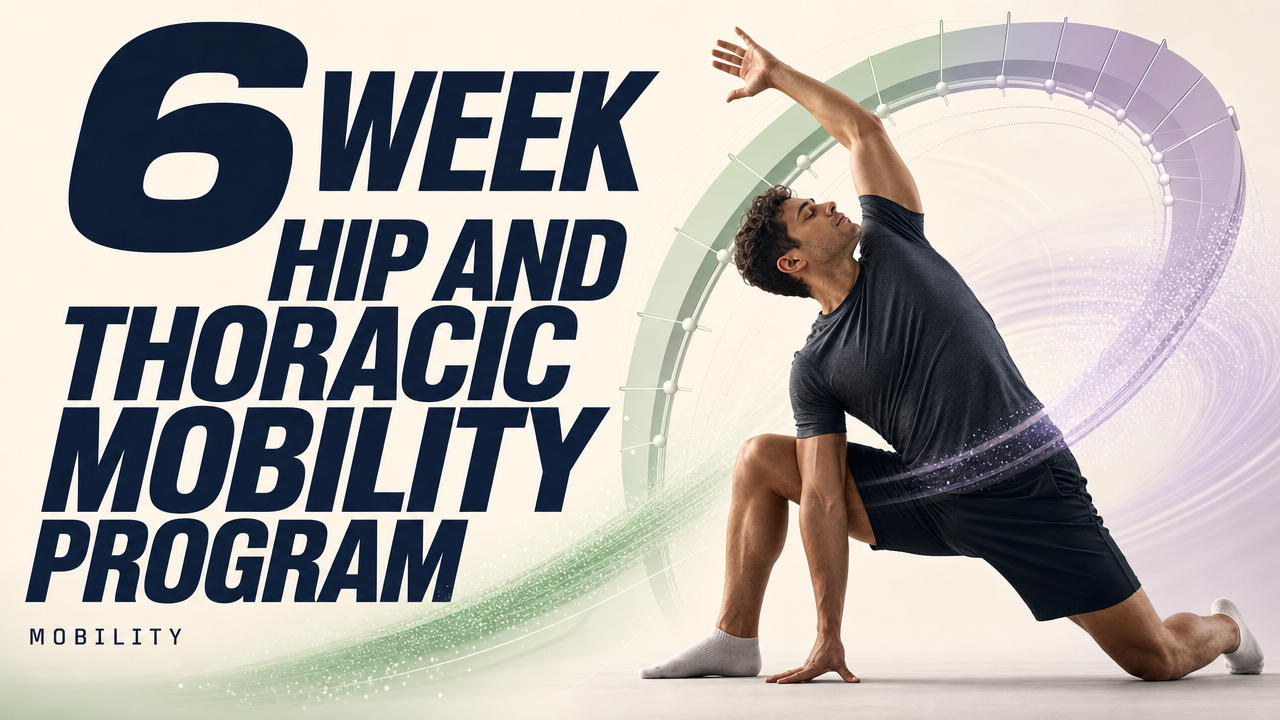
6-week hip and thoracic mobility program
v1by FitnessGrid
A progressive mobility protocol using strength-training principles to improve active range of motion in the hips and T-spine.
mobilityhip-healththoracic-spineprogressive-overloadrecovery
Get an AI coach that uses this skill
FitnessGrid is an AI coach that plans your week and adapts as you go. Install 6-week hip and thoracic mobility program and your coach will follow this protocol every week, learn from what you actually do, and adjust on the fly.
- Your coach builds the week from this skill
- Adapts to your actual progress, not a static template
- Free to start — no credit card, ~60 seconds to set up
Procedure
-
Assess User Readiness: Verify the user is seeking a structured 6-week mobility progression and confirm they have basic equipment (floor space, light weights/bench for later phases).
-
Phase 1 Setup (Weeks 1-2):
- Create a recurring workout for 3–4 days per week.
- Add exercises: Cat-Cow (2 sets x 10), Thread the Needle (2 sets x 8/side), Lunge-and-Reach (2 sets x 30s/side), 90/90 Hip Switches (2 sets x 10).
- Apply Foundation Cues: "Push floor away for mid-back curve," "Squeeze trailing glute to tilt pelvis back."
-
Phase 2 Setup (Weeks 3-5):
- Increase intensity and volume.
- Add exercises: Weighted Bench T-Spine Extension (3 sets x 10), Rotational Iso-Holds (3 sets x 10s), PAILs/RAILs 90/90 (3 sets x 2 reps/side), Weighted Cossack Squats (3 sets x 8/side).
- Apply Overload Rules: Increase Time Under Tension (e.g., extend isometric holds), increase external resistance (light weights/bands), or increase depth (ROM).
-
Phase 3 Setup (Week 6 Deload):
- Reduce frequency to 2-3 sessions per week.
- Reduce volume: Cut total sets and reps by 30–50% (1-2 sets max).
- Limit intensity: Stop 2 inches short of maximum ROM and focus on fluid movement (Cat-Cow, Hip Switches).
- Advise recovery modalities: Foam rolling and light dynamic movement.
-
Technical Support & Safety:
- Use
create_noteto document cues for correcting common errors like lumbar compensation (tuck ribs) and knee valgus (track knee over second toe). - Remind the user to maintain active tension at end-ranges to trigger neurological adaptation.
- Use
-
Progress Tracking:
- At the end of each phase, prompt the user for feedback on ROM improvements to adjust loading for the subsequent phase.


